
How Humidity Control Extends Equipment Lifespan
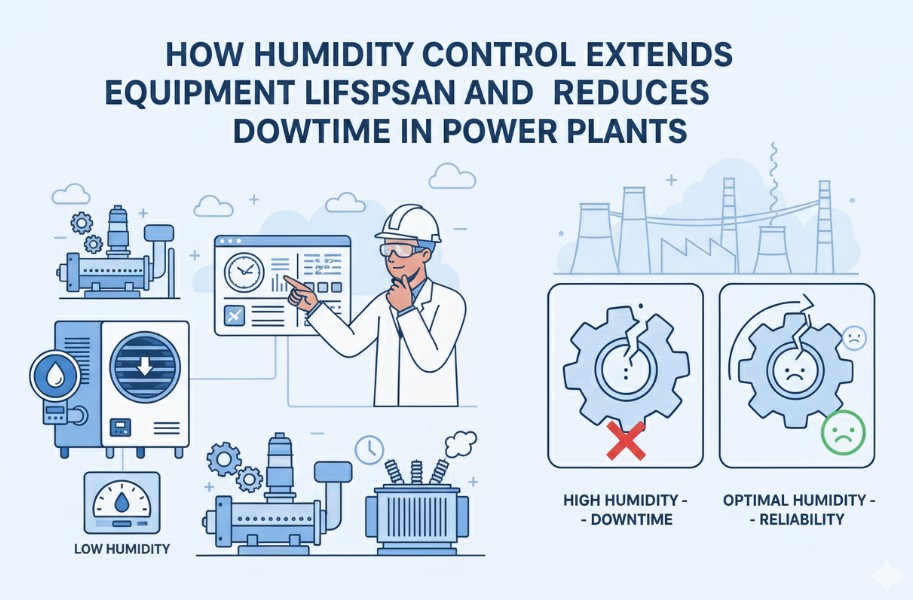
How Humidity Control Extends Equipment Lifespan and Reduces Downtime in Power Plants
Picture this: It’s 3 AM on a sweltering summer night when alarms start blaring at a 500-MW coal-fired power plant. The main generator has tripped offline due to insulation failure in the stator windings. As engineers scramble to diagnose the problem, they discover the culprit—excessive moisture had slowly degraded the electrical insulation over months, finally causing a catastrophic short circuit. The result? $500,000 per day in lost revenue while emergency repairs drag on for a week.
This scenario plays out more often than you’d think. What many plant operators don’t realize is that humidity control extends equipment lifespan power plants by directly addressing the root cause of such failures. Through strategic dehumidification power plants and comprehensive moisture control electrical equipment, facilities can slash maintenance costs, prevent unexpected outages, and add years to critical asset lifecycles.
The truth is, humidity isn’t just a comfort issue—it’s a silent destroyer of power generation equipment. From accelerated corrosion prevention power plants need to electrical insulation breakdown, uncontrolled moisture creates a cascade of problems that compound over time. But here’s the good news: targeted humidity management delivers measurable results, often with payback periods under 18 months.
In this comprehensive guide, we’ll explore the science behind moisture-related equipment failure, reveal proven strategies for power plant maintenance costs reduction, and show you real-world examples of facilities that transformed their reliability uptime through smart humidity control investments.
Why Relative Humidity Matters More Than You Think
Let’s start with the basics. Relative humidity (RH) measures the percentage of water vapor present in air compared to the maximum it can hold at a given temperature. Sounds simple enough, right? But in power plants, this seemingly innocent metric can make or break your operational success.
Most facilities target 30-50% RH in turbine halls and 40-60% in switchgear rooms, but these ranges aren’t arbitrary—they’re based on decades of hard-learned lessons about equipment preservation. [Research shows that extreme weather and humidity fluctuations cause premature aging in medium voltage
equipment](https://blog.se.com/energy-management-energy-efficiency/2018/02/22/how-extreme-weather-causes-premature-aging-in-medium-voltage-equipment/), making precise environmental control systems absolutely critical.
Here’s a sobering statistic that should grab every plant manager’s attention: every 10% increase in relative humidity can accelerate corrosion rates by up to 5%. That might not sound dramatic, but when you’re talking about multi-million-dollar turbines and generators, those percentage points translate to serious money.
The Five Hidden Risks Lurking in Your Plant
Power plant equipment corrosion prevention starts with understanding exactly what high humidity does to your assets:
- Accelerated metal oxidation: Moist air acts like a catalyst for electrochemical reactions, turning your pristine steel components into rust buckets. [Studies indicate that power plants face significant corrosion challenges](https://brothers-equipment.com/top-10-reasons-why-power-plants-need-dehumidifiers/) that can be mitigated through proper humidity management.
- Electrical insulation breakdown: When moisture penetrates generator windings and transformer insulation, resistance drops and failure risk skyrockets. [Protecting electrical insulation against moisture is crucial for keeping outages on schedule](https://www.ccj-online.com/generators-motors-protecting-electrical-insulation-against-moisture-dirt-helps-keep-outages-on-schedule/).
- Microbial growth: High humidity creates perfect breeding grounds for mold and bacteria in air handling systems, compromising both equipment performance and worker health.
- Seal degradation: Rubber gaskets and polymer seals either swell or shrink when exposed to moisture fluctuations, leading to leaks and mechanical failures.
- Unexpected safety hazards: Moisture-induced electrical faults don’t just cost money—they can endanger personnel and trigger regulatory violations.
- Actionable Tip: Install wireless RH sensors in your three most critical zones: main turbine hall, primary switchgear room, and control building. Set up text alerts when levels exceed 55% so you can respond before problems develop.
The Science of Equipment Lifespan Extension
Now here’s where things get interesting. Dehumidification extends equipment life through three distinct mechanisms that most operators never fully appreciate.
Mechanism 1: Corrosion Inhibition at the Molecular Level
When you control humidity, you’re literally slowing down chemistry. Corrosion is an electrochemical process that requires water molecules to facilitate the transfer of electrons between metal atoms and oxygen. Remove the moisture catalyst, and these reactions crawl to a near standstill.
[Equipment preservation in power plants](https://www.bryair.com/industry/equipment-preservation-in-power-plants/) becomes significantly more effective when humidity levels are maintained within optimal ranges. Think of it like putting your equipment in a protective bubble—the metal surfaces stay pristine, coatings last longer, and replacement cycles extend dramatically.Mechanism 2: Electrical Insulation Integrity
Here’s something that might surprise you: moisture-free electrical windings can last 30% longer than those exposed to typical ambient humidity. The reason? Water molecules are polar, meaning they interfere with the electrical properties of insulation materials. When moisture penetrates these systems, it creates conductive pathways that lead to tracking, flashover, and eventual failure.
Mechanism 3: Mechanical Component Stability
Bearings, seals, and precision-machined parts are designed to operate within specific tolerances. Humidity swings cause materials to expand and contract, throwing these tolerances out of whack. Maintain consistent moisture levels, and your mechanical components stay happy within their design parameters.
Real-World Example: A combined-cycle facility in Texas implemented targeted dehumidification in their gas turbine bay and saw bearing service intervals increase from 6,000 to 10,000 operating hours—a 66% improvement that saved over $200,000 annually in maintenance costs alone.
Actionable Tip: Start tracking Mean Time Between Failures (MTBF) for critical components before implementing humidity control. This baseline data will help you quantify improvements and justify additional investments.
Slashing Downtime Through Strategic Moisture Management
Let’s talk about the elephant in the room: unplanned downtime. Every minute your plant sits idle costs money, and humidity-related failures are among the most preventable causes of forced outages.The numbers tell a stark story. [Industry data reveals that maintaining power plants with proper humidity control](https://www.polygongroup.com/en-US/blog/maintaining-a-power-plant-with-humidity-control/) can prevent up to 5% of annual capacity losses due to moisture-related issues. For a 500-MW plant, that’s 25 MW of additional reliable capacity—worth millions in revenue.
Case Study: Hydroelectric Success Story
A 150-MW hydroelectric station in the Pacific Northwest was experiencing frequent nuisance trips in their switchgear during the rainy season. Moisture infiltration was causing protective relays to malfunction, leading to unnecessary shutdowns and frustrated operators.
Their solution? A comprehensive humidity control reduces downtime strategy that included:
- Zoned dehumidification targeting the main electrical building
- Redundant systems for peak moisture seasons
- Predictive analytics to anticipate humidity spikes
The results were impressive: 40% fewer unplanned outages in the first 12 months, with zero humidity-related trips during what historically was their most problematic season.
Three Battle-Tested Strategies for Downtime Prevention
Strategy 1: Zone-Based Approach
Not all areas of your plant need the same level of humidity control. Focus your efforts on high-value, moisture-sensitive zones like control rooms, switchgear areas, and generator housings. This targeted approach maximizes impact while minimizing investment.
Strategy 2: Seasonal Redundancy
[Temperature, vibration, and humidity monitoring](https://www.tricocorp.com/lubricology/the-power-of-temperature,-vibration,-and-humidity-monitoring) becomes especially critical during periods of high ambient moisture. Deploy backup dehumidification capacity that automatically kicks in when primary systems are overwhelmed.
Strategy 3: Predictive Intelligence
Modern humidity control systems can learn from historical patterns and weather data to anticipate problems before they occur. This proactive approach prevents the reactive scrambling that often leads to extended outages.
Actionable Tip: Set automated alarm thresholds at 55% RH to trigger immediate HVAC or dehumidifier response. This early warning system prevents conditions from reaching critical levels where equipment damage becomes likely.
The ROI Reality: Numbers That Make Sense
Here’s where skeptical plant managers start paying attention. Humidity control ROI power generation isn’t just theoretical—it’s demonstrable and often dramatic.
The investment equation is straightforward: modest upfront capital expenditure plus minimal ongoing operational costs versus substantial savings in maintenance, downtime prevention, and equipment life extension.
Real-World ROI Analysis
Let me share some actual numbers from recent installations:
| System Type | Initial Investment | Annual Operating Cost | Annual Savings | Payback Period |
|————-|——————-|———————|—————-|—————-|
| Modular refrigerant unit | $25,000 | $3,000 | $20,000 | 1.25 years |
| Central desiccant system | $75,000 | $8,000 | $50,000 | 1.5 years |
| Hybrid zone system | $45,000 | $5,000 | $35,000 | 1.3 years |
These aren’t hypothetical projections—they’re based on actual performance data from operating facilities.
Three ROI Optimization Strategies
Maximize Utility Incentives: Many regions offer substantial rebates for energy-efficient environmental control systems. I’ve seen facilities recover 20-30% of their initial investment through these programs alone.
Smart Integration: [Advanced humidification systems in critical infrastructure](https://hisoair.com/precision-humidity-control-in-data-centers-how-advanced-humidification-systems-protect-critical-infrastructure/) demonstrate the value of connecting dehumidifiers to your existing Building Management System (BMS). This integration enables demand-driven operation, reducing unnecessary runtime and energy consumption.
Proactive Maintenance: Schedule dehumidifier service before peak humidity seasons rather than waiting for problems to develop. This simple step can prevent costly emergency repairs and ensure optimal performance when you need it most.
Actionable Tip: Document everything. Track maintenance costs, downtime incidents, and equipment replacement schedules before and after humidity control implementation. This data becomes invaluable for justifying future investments and demonstrating value to stakeholders.
Implementation Best Practices That Actually Work
Industrial dehumidifiers power generation applications require careful planning and execution. I’ve seen too many well-intentioned projects fail because of poor implementation, so let’s talk about what actually works.
The Five-Step Success Formula
Step 1: Comprehensive Site Assessment
Walk your facility with humidity sensors and identify the real problem areas. Don’t guess—measure. Hot spots often surprise even experienced operators, and your assumptions about moisture sources might be completely wrong.Step 2: Precision Capacity Sizing
Here’s where many projects go sideways. Match your dehumidifier capacity (measured in CFM and moisture removal rate) to the actual cubic footage and moisture load of each zone. Oversizing leads to short-cycling and energy waste; undersizing means inadequate control.Step 3: Technology Selection
Refrigerant dehumidifiers work well in moderate temperature environments (above 65°F) and offer lower operating costs. Desiccant systems excel in cooler conditions or where extremely low humidity levels are required. [The role of temperature and humidity control in industrial applications](https://www.electrotechsystems.com/the-role-of-temperature-and-humidity-control-in-industrial-applications/) varies significantly based on your specific operating environment.Step 4: Control System Integration
Modern dehumidifiers communicate via standard protocols like Modbus and BACnet. Integrate them with your existing control systems for centralized monitoring, automated operation, and data logging.Step 5: Operator Training and Documentation
Develop clear standard operating procedures (SOPs) and train your maintenance team on proper operation, routine service, and troubleshooting. The best equipment in the world won’t help if your team doesn’t know how to use it effectively.
The Oversizing Trap
Here’s a critical mistake I see repeatedly: facilities install dehumidifiers that are too large for their application. The logic seems sound—bigger must be better, right? Wrong.
Oversized units cycle on and off rapidly, never reaching optimal efficiency. They consume more energy, provide poor humidity control, and wear out faster. Instead, size your equipment with only a 20% safety factor above calculated requirements.
Actionable Tip: Pilot your humidity control strategy in one critical zone before rolling out plant-wide. This approach minimizes risk, provides proof of concept, and helps you refine your approach based on real operating experience.
Addressing the Skeptics: Common Concerns Debunked
Every time I present humidity control solutions, I encounter the same objections. Let me address them head-on with facts and data.
“The Upfront Cost Is Too High”
This concern usually evaporates when managers see the actual payback calculations. With typical ROI periods of 12-18 months, humidity control systems often pay for themselves faster than many other plant improvement projects.
Consider this: a single unplanned outage can cost more than a comprehensive humidity control system. The question isn’t whether you can afford to implement moisture management—it’s whether you can afford not to.
“It Adds Complexity to Our Maintenance Program”
Modern dehumidification systems are remarkably low-maintenance. Most units require only quarterly filter changes and annual coil cleaning. Compare that to the complexity of repairing corroded equipment or rewinding moisture-damaged generators.
“Integration with Existing Systems Is Too Complicated”
Today’s industrial dehumidifiers use standard communication protocols that integrate seamlessly with existing control systems. Installation typically requires minimal downtime and can often be completed during planned maintenance outages.
“Our Plant Is Too Old for Modern Solutions”
Age isn’t a barrier—it’s an opportunity. Older facilities often benefit most from humidity control because their equipment is more vulnerable to moisture-related damage. Retrofitting humidity control can extend the life of aging assets and defer costly replacements.
Actionable Tip: Start with a single critical area as a proof-of-concept project. This low-risk approach allows you to demonstrate value before committing to plant-wide implementation.
The Path Forward: Your Next Steps
The evidence is clear: humidity control extends equipment lifespan power plants while delivering measurable improvements in reliability, maintenance costs, and operational efficiency. The question isn’t whether moisture management makes sense for your facility—it’s how quickly you can implement it.
Every day you delay action, moisture continues its silent assault on your equipment. Corrosion accelerates, insulation degrades, and your maintenance costs climb. Meanwhile, facilities that have embraced strategic humidity control are enjoying extended equipment life, reduced downtime, and improved profitability.
The technology exists. The ROI is proven. The implementation strategies are well-established. What’s missing is action.
Your Immediate Action Plan
- Assess your current situation: Install temporary humidity monitoring in three critical areas to establish baseline conditions.
- Calculate your opportunity: Estimate annual maintenance costs and downtime losses that could be prevented through humidity control.
- Pilot a solution: Select one high-value area for initial implementation to prove the concept and refine your approach.
- Scale systematically: Expand successful pilot projects to additional zones based on priority and ROI potential.
- Measure and optimize: Track performance metrics to demonstrate value and identify opportunities for improvement.
The power generation industry is evolving rapidly, with increasing pressure to maximize asset utilization while minimizing costs. Facilities that embrace humidity control as a strategic advantage will thrive in this environment, while those that ignore moisture management will struggle with escalating maintenance costs and declining reliability.
Don’t let humidity be the hidden factor that undermines your plant’s performance. Take control of your environment, protect your assets, and secure your facility’s future through strategic moisture management.
Ready to transform your plant’s reliability and profitability? Contact our dehumidification experts for a comprehensive site assessment, or download our free “Power Plant Humidity Management Implementation Guide” to start your journey toward moisture-free operations today.
The choice is yours: continue fighting moisture-related problems reactively, or take proactive control and enjoy the peace of mind that comes with truly protected assets. Your equipment—and your bottom line—will thank you.
TL;DR
- Install wireless RH sensors in turbine halls and switchgear rooms to monitor moisture levels.
- Set automated alerts at 55% RH to trigger dehumidifiers before damage occurs.
- Recognize how humidity control extends equipment lifespan power plants by reducing corrosion risk.
- Pilot one critical zone to refine implementation and minimize risk with targeted data.
- Track MTBF and downtime metrics pre/post humidity control to quantify improvements.
Ensure every batch meets spec—achieve low, stable RH for APIs, coatings, and cleanrooms with Rehoboth’s pharma‑ready desiccant dehumidifiers. Speak to an engineer for a tailored solution and audit‑ready documentation. REHOBOTH at Email- sales@rbdeh.com, cmnarang@gmail.com / Phone- +91 9811 599 922.
Your Trusted Partner in Temperature and Humidity Control Solutions